


The Information and Communication Technology (ICT) Division has spent approximately Tk 800 million over the past decade developing 12 software applications and technological tools aimed at strengthening the use of Bengali in information technology. However, questions have emerged over how effectively these technologies are serving ordinary users.
The project, titled Enrichment of Bengali Language in Information Technology through Research and Development, was launched in 2016 during the Awami League government. It is being implemented by the Bangladesh Computer Council (BCC) under the ICT Division.

The project was initially allocated Tk 1.58 billion. Its tenure has been extended three times, with the latest extension setting June 2028 as the completion deadline.



Under the project, 16 software applications, technological tools and resources were planned. According to project-related sources, work on 12 of these components has been completed. However, not all the services are fully operational or easily accessible to the general public.
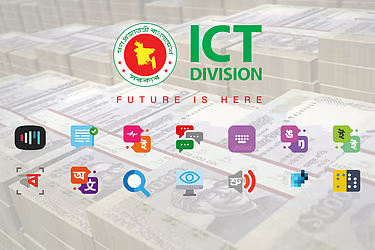
The developed technologies include optical character recognition (OCR), audio-to-text conversion, Bengali spelling and grammar checking, language translation, Bengali fonts and keyboards, screen readers for visually impaired users, Braille conversion tools and sign-language recognition technology.

An artificial intelligence-based chatbot named ‘Jiggasha’ has also been developed to provide information about government services.
Limited Use Raises Questions
Usage statistics indicate significant differences in the popularity of the project’s services.
The experimental version of the ‘Jiggasha’ chatbot receives an average of 110 requests per day. The Bengali font conversion service processed only 275 files over 35 days. In contrast, the Bengali spelling-checking service receives approximately 500,000 requests daily, while the OCR service on the Kagoj.ai platform receives around 50 requests a day.
A recent assessment of several tools found that the Bengali spelling-checking service performed relatively well. However, the audio-to-text service encountered difficulties when processing large files. The AI-powered chatbot could answer basic questions but sometimes provided misleading information when dealing with more complex queries.
Project officials said the existing graphics processing unit (GPU) capacity can support only a limited number of simultaneous users.
They claimed the current infrastructure can accommodate between 5,000 and 10,000 users at a time, but users may face waiting periods when demand increases. Additional GPU capacity and technological infrastructure would therefore be necessary to make the services widely accessible.
Tk 800 Million in Expenditure
According to project sources, approximately Tk 800 million has been spent so far. Around Tk 600 million went towards software development, hosting and data preservation. The remaining amount was spent on office management, meetings, seminars, promotional campaigns and operational activities.
Questions have nevertheless been raised about the actual costs of individual software products and whether the quality of the completed work justifies the expenditure.
Project officials say the initiative was not limited to developing software. It also aimed to build essential datasets for advancing Bengali-language artificial intelligence and language technologies.
According to project-related information, nearly 8,000 copyright-free books have been digitised. The project has collected 10,000 hours of audio data for converting Bengali speech into text and 1,000 hours for converting text into speech.
In addition, more than 12,000 minutes of audio recordings covering 44 ethnic minority languages and 42,800 sign-language videos have reportedly been collected.
Project Extension Draws Criticism
The project’s extended timeline and expenditure have prompted further scrutiny.
Some stakeholders believe the new government should have thoroughly reviewed ICT projects initiated during the previous Awami League administration, removed unnecessary activities and ensured accountability wherever irregularities were suspected.
However, the budget of the Bengali language enrichment project has not been reduced despite its extended duration.
ICT Secretary Md. Mamunur Rashid Bhuiyan acknowledged that although several technological tools had been developed, not all of them had delivered meaningful results.
He said the services had not reached the public as widely as originally intended. The division is now working to integrate the tools into a single platform and make them more user-friendly.
He also said that ongoing ICT projects had been reviewed and unnecessary components removed. Between 10 and 12 projects underwent reassessment.
Project Director Mahbub Karim said the technology and databases would eventually be handed over to the Bangladesh Computer Council after completion. He added that additional GPUs could be purchased and technological capacity expanded if required.
Questions Over Earlier ICT Projects
During the Awami League government’s tenure, 21 projects were undertaken in the ICT sector under the broader initiative of building a Digital Bangladesh. According to the ICT Division, their combined approved expenditure was approximately Tk 19 billion.
A 12-member committee was formed on August 28, 2024, to review those projects. Its report identified activities that were inconsistent with project objectives, as well as components falling outside the jurisdiction of the ICT Division.
The committee estimated that approximately Tk 69.81 billion could be saved by removing unnecessary components.

Commenting on alleged irregularities in ICT projects, Professor B. M. Mainul Hossain of the Institute of Information Technology at the University of Dhaka said extending project deadlines without properly reviewing past practices and outcomes would effectively encourage previous misconduct.
Despite the substantial investment and a decade of development work, questions remain over the practical usefulness of the Bengali-language technologies, their accessibility to ordinary citizens and their long-term maintenance.
A key concern is who will be responsible for keeping these services operational and ensuring public access after the project officially ends.