



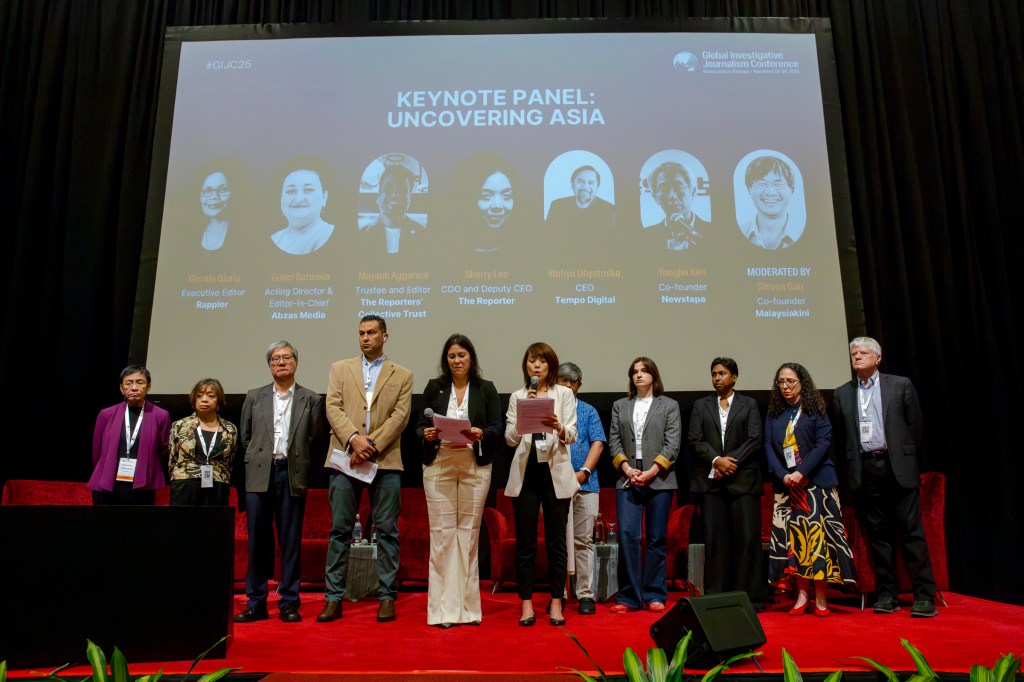
Participants also pressed governments to ensure journalists can report freely and safely during the action at the opening session of the Global Investigative Journalism Conference in Malaysia on November 21. The conference is attended by more than 1,500 people from 135 countries and territories.
Prominent journalists, including Nobel Peace laureate and CPJ board member Maria Ressa, joined CPJ on stage and held up a banner with the message “Journalism is not a crime”, after a solidarity statement was read out by CPJ’s Chief Global Affairs Officer Gypsy Guillén Kaiser and Asia-Pacific Director Beh Lih Yi.
Read the full statement below:
Today is the deadliest time to be a journalist since the Committee to Protect Journalists began keeping records in 1992. In a world where democracy is in retreat and autocracy is on the rise, a free, pluralistic media is in crisis. The need to be alarmed and to act is undeniable.
Imprisonment and killings have reached record levels. At the same time, journalists are being surveilled, criminalized, smeared, and forced to flee for their safety.
Never before have we seen a horror like that perpetrated by Israel on journalists in Gaza, with nearly 250 killed in this war. From Ukraine to Ethiopia and Myanmar to Sudan, journalists – who are civilians under international law – have been kidnapped, raped, displaced, discredited, imprisoned, targeted with drones and murdered as the rules of war are ignored with impunity.
In the rest of the world, compounding and connected aggressions are severely hindering journalists’ ability to report freely and safely. At times, these assaults are chilling coverage, extracting immense legal fees, and perpetrating fear and trauma.
An unprecedented number of journalists are in prison because of their work. In 2024, CPJ recorded a new global high of more than 370 journalists behind bars. This region — Asia — has the distinction of holding the most journalists in prison, accounting for more than 30% of the global total.
Whether buried or behind bars, these journalists are our colleagues. They were reporting on corruption, politics, and conflicts. All of them were doing work that makes our societies safer, healthier, and more equal. At a bare minimum, journalists must stand up for journalists.
Solidarity among journalists is needed more than ever. But it is not new. Journalists in Mexico regularly honor their fallen colleagues, like Regina Martinez, murdered in 2012 for reporting on drug cartels. They stand with Jimmy Lai, whose jailing in Hong Kong marked the beginning of the end of rule of law. In a show of unity, dozens of journalists from at least 30 news outlets rejected new Pentagon rules that would compromise their reporting. In 2018, tens of thousands filled the streets in Slovakia to clamor for justice over the murder of investigative journalist Ján Kuciak, who had exposed corruption.
As a journalistic community we must craft and replicate a playbook to stand up together. Solidarity matters.
We now invite you to join us and stand with our colleagues around the world who are facing reprisals for reporting the facts.
At the 2025 Global Investigative Journalism Conference in Malaysia, we, more than 1,500 journalists representing over 100 countries, call on governments to immediately free journalists who are jailed or detained arbitrarily, and to end impunity for those who attack the press.
We demand that governments and the international community commit to protecting and promoting media freedom, and to ensuring that journalists can work freely and without fear of reprisal.
Truth can move mountains. We have the power of truth. Journalists are neither criminals nor targets. Let’s protect each other, fight for one another and together, we will show the world that journalism is not a crime.


Participants also pressed governments to ensure journalists can report freely and safely during the action at the opening session of the Global Investigative Journalism Conference in Malaysia on November 21. The conference is attended by more than 1,500 people from 135 countries and territories.
Prominent journalists, including Nobel Peace laureate and CPJ board member Maria Ressa, joined CPJ on stage and held up a banner with the message “Journalism is not a crime”, after a solidarity statement was read out by CPJ’s Chief Global Affairs Officer Gypsy Guillén Kaiser and Asia-Pacific Director Beh Lih Yi.
Read the full statement below:
Today is the deadliest time to be a journalist since the Committee to Protect Journalists began keeping records in 1992. In a world where democracy is in retreat and autocracy is on the rise, a free, pluralistic media is in crisis. The need to be alarmed and to act is undeniable.
Imprisonment and killings have reached record levels. At the same time, journalists are being surveilled, criminalized, smeared, and forced to flee for their safety.
Never before have we seen a horror like that perpetrated by Israel on journalists in Gaza, with nearly 250 killed in this war. From Ukraine to Ethiopia and Myanmar to Sudan, journalists – who are civilians under international law – have been kidnapped, raped, displaced, discredited, imprisoned, targeted with drones and murdered as the rules of war are ignored with impunity.
In the rest of the world, compounding and connected aggressions are severely hindering journalists’ ability to report freely and safely. At times, these assaults are chilling coverage, extracting immense legal fees, and perpetrating fear and trauma.
An unprecedented number of journalists are in prison because of their work. In 2024, CPJ recorded a new global high of more than 370 journalists behind bars. This region — Asia — has the distinction of holding the most journalists in prison, accounting for more than 30% of the global total.
Whether buried or behind bars, these journalists are our colleagues. They were reporting on corruption, politics, and conflicts. All of them were doing work that makes our societies safer, healthier, and more equal. At a bare minimum, journalists must stand up for journalists.
Solidarity among journalists is needed more than ever. But it is not new. Journalists in Mexico regularly honor their fallen colleagues, like Regina Martinez, murdered in 2012 for reporting on drug cartels. They stand with Jimmy Lai, whose jailing in Hong Kong marked the beginning of the end of rule of law. In a show of unity, dozens of journalists from at least 30 news outlets rejected new Pentagon rules that would compromise their reporting. In 2018, tens of thousands filled the streets in Slovakia to clamor for justice over the murder of investigative journalist Ján Kuciak, who had exposed corruption.
As a journalistic community we must craft and replicate a playbook to stand up together. Solidarity matters.
We now invite you to join us and stand with our colleagues around the world who are facing reprisals for reporting the facts.
At the 2025 Global Investigative Journalism Conference in Malaysia, we, more than 1,500 journalists representing over 100 countries, call on governments to immediately free journalists who are jailed or detained arbitrarily, and to end impunity for those who attack the press.
We demand that governments and the international community commit to protecting and promoting media freedom, and to ensuring that journalists can work freely and without fear of reprisal.
Truth can move mountains. We have the power of truth. Journalists are neither criminals nor targets. Let’s protect each other, fight for one another and together, we will show the world that journalism is not a crime.

Participants also pressed governments to ensure journalists can report freely and safely during the action at the opening session of the Global Investigative Journalism Conference in Malaysia on November 21. The conference is attended by more than 1,500 people from 135 countries and territories.
Prominent journalists, including Nobel Peace laureate and CPJ board member Maria Ressa, joined CPJ on stage and held up a banner with the message “Journalism is not a crime”, after a solidarity statement was read out by CPJ’s Chief Global Affairs Officer Gypsy Guillén Kaiser and Asia-Pacific Director Beh Lih Yi.
Read the full statement below:
Today is the deadliest time to be a journalist since the Committee to Protect Journalists began keeping records in 1992. In a world where democracy is in retreat and autocracy is on the rise, a free, pluralistic media is in crisis. The need to be alarmed and to act is undeniable.
Imprisonment and killings have reached record levels. At the same time, journalists are being surveilled, criminalized, smeared, and forced to flee for their safety.
Never before have we seen a horror like that perpetrated by Israel on journalists in Gaza, with nearly 250 killed in this war. From Ukraine to Ethiopia and Myanmar to Sudan, journalists – who are civilians under international law – have been kidnapped, raped, displaced, discredited, imprisoned, targeted with drones and murdered as the rules of war are ignored with impunity.
In the rest of the world, compounding and connected aggressions are severely hindering journalists’ ability to report freely and safely. At times, these assaults are chilling coverage, extracting immense legal fees, and perpetrating fear and trauma.
An unprecedented number of journalists are in prison because of their work. In 2024, CPJ recorded a new global high of more than 370 journalists behind bars. This region — Asia — has the distinction of holding the most journalists in prison, accounting for more than 30% of the global total.
Whether buried or behind bars, these journalists are our colleagues. They were reporting on corruption, politics, and conflicts. All of them were doing work that makes our societies safer, healthier, and more equal. At a bare minimum, journalists must stand up for journalists.
Solidarity among journalists is needed more than ever. But it is not new. Journalists in Mexico regularly honor their fallen colleagues, like Regina Martinez, murdered in 2012 for reporting on drug cartels. They stand with Jimmy Lai, whose jailing in Hong Kong marked the beginning of the end of rule of law. In a show of unity, dozens of journalists from at least 30 news outlets rejected new Pentagon rules that would compromise their reporting. In 2018, tens of thousands filled the streets in Slovakia to clamor for justice over the murder of investigative journalist Ján Kuciak, who had exposed corruption.
As a journalistic community we must craft and replicate a playbook to stand up together. Solidarity matters.
We now invite you to join us and stand with our colleagues around the world who are facing reprisals for reporting the facts.
At the 2025 Global Investigative Journalism Conference in Malaysia, we, more than 1,500 journalists representing over 100 countries, call on governments to immediately free journalists who are jailed or detained arbitrarily, and to end impunity for those who attack the press.
We demand that governments and the international community commit to protecting and promoting media freedom, and to ensuring that journalists can work freely and without fear of reprisal.
Truth can move mountains. We have the power of truth. Journalists are neither criminals nor targets. Let’s protect each other, fight for one another and together, we will show the world that journalism is not a crime.
Participants also pressed governments to ensure journalists can report freely and safely during the action at the opening session of the Global Investigative Journalism Conference in Malaysia on November 21. The conference is attended by more than 1,500 people from 135 countries and territories.
Prominent journalists, including Nobel Peace laureate and CPJ board member Maria Ressa, joined CPJ on stage and held up a banner with the message “Journalism is not a crime”, after a solidarity statement was read out by CPJ’s Chief Global Affairs Officer Gypsy Guillén Kaiser and Asia-Pacific Director Beh Lih Yi.
Read the full statement below:
Today is the deadliest time to be a journalist since the Committee to Protect Journalists began keeping records in 1992. In a world where democracy is in retreat and autocracy is on the rise, a free, pluralistic media is in crisis. The need to be alarmed and to act is undeniable.
Imprisonment and killings have reached record levels. At the same time, journalists are being surveilled, criminalized, smeared, and forced to flee for their safety.
Never before have we seen a horror like that perpetrated by Israel on journalists in Gaza, with nearly 250 killed in this war. From Ukraine to Ethiopia and Myanmar to Sudan, journalists – who are civilians under international law – have been kidnapped, raped, displaced, discredited, imprisoned, targeted with drones and murdered as the rules of war are ignored with impunity.
In the rest of the world, compounding and connected aggressions are severely hindering journalists’ ability to report freely and safely. At times, these assaults are chilling coverage, extracting immense legal fees, and perpetrating fear and trauma.
An unprecedented number of journalists are in prison because of their work. In 2024, CPJ recorded a new global high of more than 370 journalists behind bars. This region — Asia — has the distinction of holding the most journalists in prison, accounting for more than 30% of the global total.
Whether buried or behind bars, these journalists are our colleagues. They were reporting on corruption, politics, and conflicts. All of them were doing work that makes our societies safer, healthier, and more equal. At a bare minimum, journalists must stand up for journalists.
Solidarity among journalists is needed more than ever. But it is not new. Journalists in Mexico regularly honor their fallen colleagues, like Regina Martinez, murdered in 2012 for reporting on drug cartels. They stand with Jimmy Lai, whose jailing in Hong Kong marked the beginning of the end of rule of law. In a show of unity, dozens of journalists from at least 30 news outlets rejected new Pentagon rules that would compromise their reporting. In 2018, tens of thousands filled the streets in Slovakia to clamor for justice over the murder of investigative journalist Ján Kuciak, who had exposed corruption.
As a journalistic community we must craft and replicate a playbook to stand up together. Solidarity matters.
We now invite you to join us and stand with our colleagues around the world who are facing reprisals for reporting the facts.
At the 2025 Global Investigative Journalism Conference in Malaysia, we, more than 1,500 journalists representing over 100 countries, call on governments to immediately free journalists who are jailed or detained arbitrarily, and to end impunity for those who attack the press.
We demand that governments and the international community commit to protecting and promoting media freedom, and to ensuring that journalists can work freely and without fear of reprisal.
Truth can move mountains. We have the power of truth. Journalists are neither criminals nor targets. Let’s protect each other, fight for one another and together, we will show the world that journalism is not a crime.

Participants also pressed governments to ensure journalists can report freely and safely during the action at the opening session of the Global Investigative Journalism Conference in Malaysia on November 21. The conference is attended by more than 1,500 people from 135 countries and territories.
Prominent journalists, including Nobel Peace laureate and CPJ board member Maria Ressa, joined CPJ on stage and held up a banner with the message “Journalism is not a crime”, after a solidarity statement was read out by CPJ’s Chief Global Affairs Officer Gypsy Guillén Kaiser and Asia-Pacific Director Beh Lih Yi.
Read the full statement below:
Today is the deadliest time to be a journalist since the Committee to Protect Journalists began keeping records in 1992. In a world where democracy is in retreat and autocracy is on the rise, a free, pluralistic media is in crisis. The need to be alarmed and to act is undeniable.
Imprisonment and killings have reached record levels. At the same time, journalists are being surveilled, criminalized, smeared, and forced to flee for their safety.
Never before have we seen a horror like that perpetrated by Israel on journalists in Gaza, with nearly 250 killed in this war. From Ukraine to Ethiopia and Myanmar to Sudan, journalists – who are civilians under international law – have been kidnapped, raped, displaced, discredited, imprisoned, targeted with drones and murdered as the rules of war are ignored with impunity.
In the rest of the world, compounding and connected aggressions are severely hindering journalists’ ability to report freely and safely. At times, these assaults are chilling coverage, extracting immense legal fees, and perpetrating fear and trauma.
An unprecedented number of journalists are in prison because of their work. In 2024, CPJ recorded a new global high of more than 370 journalists behind bars. This region — Asia — has the distinction of holding the most journalists in prison, accounting for more than 30% of the global total.
Whether buried or behind bars, these journalists are our colleagues. They were reporting on corruption, politics, and conflicts. All of them were doing work that makes our societies safer, healthier, and more equal. At a bare minimum, journalists must stand up for journalists.
Solidarity among journalists is needed more than ever. But it is not new. Journalists in Mexico regularly honor their fallen colleagues, like Regina Martinez, murdered in 2012 for reporting on drug cartels. They stand with Jimmy Lai, whose jailing in Hong Kong marked the beginning of the end of rule of law. In a show of unity, dozens of journalists from at least 30 news outlets rejected new Pentagon rules that would compromise their reporting. In 2018, tens of thousands filled the streets in Slovakia to clamor for justice over the murder of investigative journalist Ján Kuciak, who had exposed corruption.
As a journalistic community we must craft and replicate a playbook to stand up together. Solidarity matters.
We now invite you to join us and stand with our colleagues around the world who are facing reprisals for reporting the facts.
At the 2025 Global Investigative Journalism Conference in Malaysia, we, more than 1,500 journalists representing over 100 countries, call on governments to immediately free journalists who are jailed or detained arbitrarily, and to end impunity for those who attack the press.
We demand that governments and the international community commit to protecting and promoting media freedom, and to ensuring that journalists can work freely and without fear of reprisal.
Truth can move mountains. We have the power of truth. Journalists are neither criminals nor targets. Let’s protect each other, fight for one another and together, we will show the world that journalism is not a crime.

Participants also pressed governments to ensure journalists can report freely and safely during the action at the opening session of the Global Investigative Journalism Conference in Malaysia on November 21. The conference is attended by more than 1,500 people from 135 countries and territories.
Prominent journalists, including Nobel Peace laureate and CPJ board member Maria Ressa, joined CPJ on stage and held up a banner with the message “Journalism is not a crime”, after a solidarity statement was read out by CPJ’s Chief Global Affairs Officer Gypsy Guillén Kaiser and Asia-Pacific Director Beh Lih Yi.
Read the full statement below:
Today is the deadliest time to be a journalist since the Committee to Protect Journalists began keeping records in 1992. In a world where democracy is in retreat and autocracy is on the rise, a free, pluralistic media is in crisis. The need to be alarmed and to act is undeniable.
Imprisonment and killings have reached record levels. At the same time, journalists are being surveilled, criminalized, smeared, and forced to flee for their safety.
Never before have we seen a horror like that perpetrated by Israel on journalists in Gaza, with nearly 250 killed in this war. From Ukraine to Ethiopia and Myanmar to Sudan, journalists – who are civilians under international law – have been kidnapped, raped, displaced, discredited, imprisoned, targeted with drones and murdered as the rules of war are ignored with impunity.
In the rest of the world, compounding and connected aggressions are severely hindering journalists’ ability to report freely and safely. At times, these assaults are chilling coverage, extracting immense legal fees, and perpetrating fear and trauma.
An unprecedented number of journalists are in prison because of their work. In 2024, CPJ recorded a new global high of more than 370 journalists behind bars. This region — Asia — has the distinction of holding the most journalists in prison, accounting for more than 30% of the global total.
Whether buried or behind bars, these journalists are our colleagues. They were reporting on corruption, politics, and conflicts. All of them were doing work that makes our societies safer, healthier, and more equal. At a bare minimum, journalists must stand up for journalists.
Solidarity among journalists is needed more than ever. But it is not new. Journalists in Mexico regularly honor their fallen colleagues, like Regina Martinez, murdered in 2012 for reporting on drug cartels. They stand with Jimmy Lai, whose jailing in Hong Kong marked the beginning of the end of rule of law. In a show of unity, dozens of journalists from at least 30 news outlets rejected new Pentagon rules that would compromise their reporting. In 2018, tens of thousands filled the streets in Slovakia to clamor for justice over the murder of investigative journalist Ján Kuciak, who had exposed corruption.
As a journalistic community we must craft and replicate a playbook to stand up together. Solidarity matters.
We now invite you to join us and stand with our colleagues around the world who are facing reprisals for reporting the facts.
At the 2025 Global Investigative Journalism Conference in Malaysia, we, more than 1,500 journalists representing over 100 countries, call on governments to immediately free journalists who are jailed or detained arbitrarily, and to end impunity for those who attack the press.
We demand that governments and the international community commit to protecting and promoting media freedom, and to ensuring that journalists can work freely and without fear of reprisal.
Truth can move mountains. We have the power of truth. Journalists are neither criminals nor targets. Let’s protect each other, fight for one another and together, we will show the world that journalism is not a crime.