


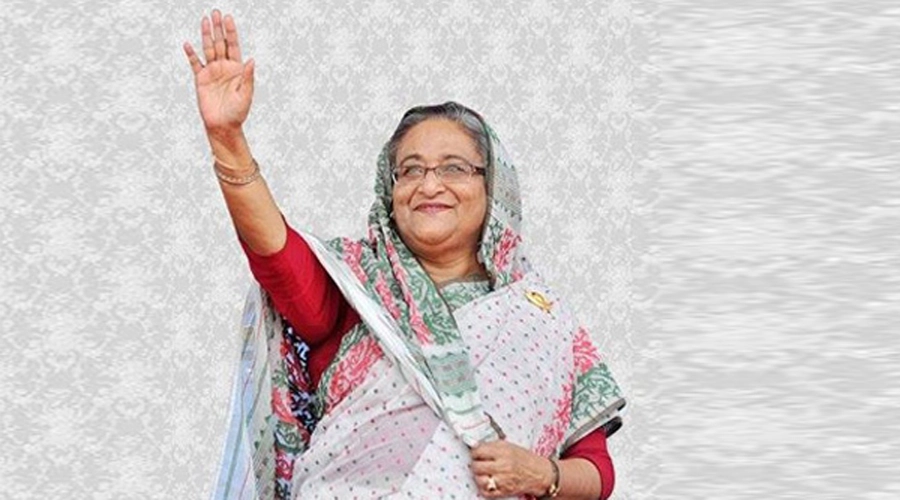
Former Bangladesh Prime Minister Sheikh Hasina has reaffirmed her determination to return to Bangladesh from India in December, declaring that she will come back “at any cost” despite having been sentenced to death by a special tribunal over crimes against humanity linked to the deadly crackdown on protesters during the July 2024 uprising.
In an interview with The Associated Press (AP), Hasina said her decision to return to her homeland remained unchanged, despite the possibility of arrest, imprisonment, torture or even death upon her arrival.
RelatedPost



“If death is my destiny, I would rather die on the soil of my own country, among my own people,” Hasina told AP in written responses. “So, I will return to Bangladesh. That decision has not changed.”
Hasina, who was removed from power following the student-led mass uprising in August 2024, fled to India and has remained there since. She had first announced her intention to return in December during an earlier statement in August.
In 2025, a special tribunal in Bangladesh sentenced her to death for crimes against humanity, ruling that she was responsible for ordering the crackdown on protesters. The United Nations previously reported that nearly 1,400 people were killed during the violence, while thousands more were injured.
Hasina has consistently denied wrongdoing, rejected the tribunal’s verdict and questioned the legitimacy of the judicial proceedings.
Bangladesh has repeatedly requested India’s cooperation in extraditing the former prime minister. However, New Delhi has so far declined to hand her over.
Hasina did not disclose how she intends to return to Bangladesh. She acknowledged that she could face immediate arrest upon arrival.
“I know that I may be arrested when I return. I may be imprisoned, tortured or even killed. I am fully aware of those possibilities. But I cannot spend the rest of my life watching my people suffer from a distance,” she told AP.
Political landscape and Awami League under pressure
Following Hasina’s departure, Nobel Peace Prize laureate Muhammad Yunus headed an interim administration that governed Bangladesh for approximately 18 months.
In February 2026, Tarique Rahman, son of former Prime Minister Khaleda Zia and a longtime political rival of Hasina, came to power after securing a landslide victory in a general election held under the Yunus-led administration. The Awami League was barred from participating in the election.
Hasina’s proposed return comes at a time when the Awami League is facing an uncertain political future. The party remains banned from political activities, while several senior leaders have been arrested or forced into exile.
Hasina alleged that at least 20,000 Awami League members had been killed since August 2024. She further claimed that thousands of party activists and supporters had been arrested, tortured or forced into hiding, while many had lost their homes, businesses and livelihoods because of their political affiliations.
“There is no normal political or democratic environment,” she said, accusing the authorities of systematically suppressing her party and its supporters.
The current government maintains that arrests are being made in connection with specific criminal allegations.
Concerns over human rights and democratic freedoms

Hasina also raised concerns about the state of civil and political rights in Bangladesh under the current administration.
Several international human rights organisations, including Human Rights Watch, have criticised the government over alleged violations of civil liberties and political rights in recent months.


The political environment has also drawn international attention amid concerns over the growing influence of extremist groups and reports of intimidation against minority communities. The Yunus-led administration had previously rejected allegations of failing to protect vulnerable communities.
Hasina, who maintained a hard-line position against extremist groups during her 15 years in power, expressed concern about what she described as the growing influence of hard-line elements in Bangladesh.
“The present political environment has allowed extremist elements to become more confident,” she said.

Rejects foreign protection, insists on returning home
Asked whether she expected countries such as India and the United States to put pressure on Bangladesh to guarantee her safe return, Hasina said she was not seeking protection from foreign governments.
“I value friendship and cooperation with all nations. That has always been our (Bangladesh’s) foreign policy. But I do not need the blessing of a foreign power to return to my own country,” she said.
Her remarks underline her determination to return despite the serious legal and political challenges awaiting her.
The Press Wing of the Prime Minister’s Office did not respond to an Associated Press request for comment on Hasina’s allegations and statements.
Her proposed December return could become a significant political development for Bangladesh, potentially reshaping the country’s political debate over accountability, democratic participation, human rights and the future of the Awami League.