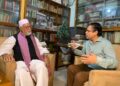



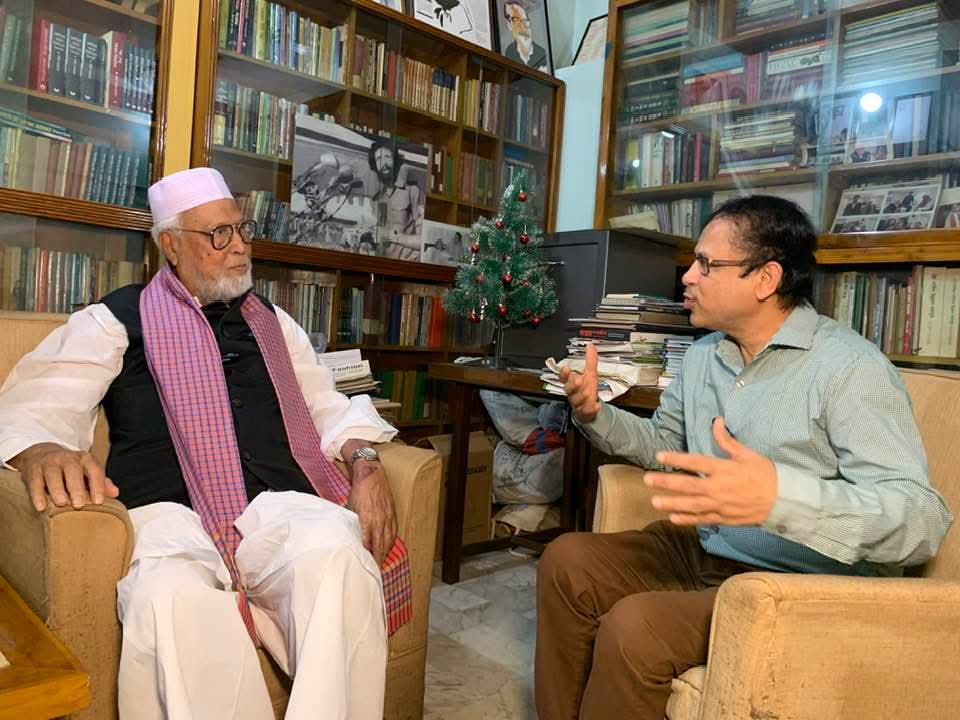
Bir Bikram Kader Siddique speaks candidly on the Liberation War, Awami League’s downfall, Jamaat’s role, the interim government’s failures and Tarique Rahman’s political responsibilities
Bir Bikram Abdul Kader Siddique, president of the Krishak Sramik Janata League, has shared his views on the spirit of the Liberation War, Bangladesh’s current political landscape, the future of the Awami League, Jamaat-e-Islami’s role and the challenges of governing the country.
He believes that people have increasingly lost their understanding of the historical significance of the slogans “Joy Bangla” and “Zindabad”—including which sentiment should be embraced and which should be rejected.
RelatedPost



In an interview with Sangbad, Siddique discussed these issues at length. The interview was conducted by Rashed Ahmed.
Question: Bangladesh witnessed a major political change in 2024. Since then, there have been incidents of disrespect towards the Liberation War and its spirit. Why has this happened?
Kader Siddique: There must be reasons behind such a crisis, 54–55 years after independence. Many of us who participated in the Liberation War and freed the country from Pakistani occupation failed to remain sufficiently conscious and active in the years that followed.
Many children of freedom fighters did not receive adequate educational opportunities. On the other hand, the defeated forces, including those associated with the Razakars, Al-Badr and Jamaat-e-Islami, focused on education, organisation and expanding their influence in different sectors.
Our negligence and complacency are partly responsible. Bangabandhu Sheikh Mujibur Rahman was assassinated on August 15, 1975. His assassination was connected not only to domestic politics but also to international power calculations. During the Liberation War, apart from India and the Soviet Union, we did not receive support from the major global powers. The assassination of Bangabandhu and subsequent political developments must also be understood in that international context.
Question: After the political change in 2024, the Liberation War came under greater attack. Your elder brother was reportedly humiliated while trying to participate in an event related to the Liberation War. You have also faced humiliation on several occasions. Why has this situation emerged?
Kader Siddique: This is not entirely unexpected. We have our weaknesses and shortcomings, while defeated forces always try to regain their position. Those who lose once continue striving for another victory. But those who win often fail to do enough to preserve their victory. The same thing happened in Bangladesh.
We should have understood our own mistakes. I do not think we have yet developed that level of awareness.
Question: Are you referring to the current government?
Kader Siddique: Not just the government. I have never limited my concerns to the government alone. My concerns extend to the Liberation War and the entire population of the country. I do not believe that the government should be held solely responsible for everything.
Question: Then what should be done now?
Kader Siddique: I am not absolving the government of its responsibilities. But I am also not saying that the government bears every responsibility. We need overall moral, mental and humanitarian development.
The transformation in people’s character during the Liberation War was extraordinary. I do not know whether any other country experienced something similar.
The Pakistani occupation forces could torture and kill supporters of Bangladesh, but they could not force them to support Pakistan. Those who wanted Bangladesh said “Joy Bangla”, while those who supported Pakistan said “Zindabad”. Joy Bangla represented the aspirations of the Bengali people for independence, while Zindabad symbolised support for Pakistan.
I personally witnessed incidents in which Pakistani supporters or spies, even after being captured, refused to say Joy Bangla despite intense pressure. Similarly, the Pakistani forces could not force supporters of the Liberation War to say Pakistan Zindabad, even through torture.
Yet today, we have largely lost our understanding of what Joy Bangla and Zindabad represent, which sentiment should be embraced and which should be rejected.
Question: A new slogan, ‘Inqilab Zindabad’, has become prominent since 2024. What is your view?
Kader Siddique: Inqilab is a good word. But the meaning of a word alone does not determine whether its use or purpose is good.
Take the word Razakar, for example. Its original meaning is someone who helps or provides assistance to Muslims. Those who helped Prophet Muhammad (PBUH) in Medina were also described as Razakars. But in Bangladesh, the word has become one of the most despised labels.
Jamaat took Pakistan’s side during the Liberation War and helped organise the Razakar, Al-Badr and Al-Shams forces. Its leader, Abul A’la Maududi, also had a controversial position during the establishment of Pakistan. Later, when Bangladesh fought for independence, Jamaat again sided with Pakistan.
There is a difference between politically supporting Pakistan and organising armed groups that destroyed homes, committed arson, killed people and handed women over to Pakistani forces for sexual violence. Had Jamaat not engaged in such crimes, the criticism of its political position might have been different.


If Jamaat wants to earn a place in the hearts of the people of Bangladesh, it must offer a sincere and profound apology. It must seek forgiveness from the people with even greater remorse than someone seeking forgiveness from Allah. Whether the people will forgive them is another matter.
Question: Why did your relationship with the Awami League deteriorate? You considered Bangabandhu your political father and had a brother-sister relationship with Sheikh Hasina. Why did you leave the party and form a new one?
Kader Siddique: Bangabandhu treated me like his son, and I considered him a father. Whatever I could do for my biological father, I could do for Bangabandhu. He was my political father. Through him, I came to understand my country.
I did not leave Bangabandhu’s Awami League, Maulana Bhashani’s Awami League, Shamsul Haque’s Awami League or the Awami League of the Liberation War. I left the Awami League led by my sister, Sheikh Hasina.
During Bangabandhu’s time, ordinary party workers were respected and valued. But towards the end of Sheikh Hasina’s rule, ordinary workers had little importance. The party increasingly valued wealthy hybrid leaders and those who wore suits and ties.
The rural women who sold their earrings to support the party and feed its leaders received little recognition.
I am someone who cannot feel at ease after making a commitment without fulfilling it. I felt that the promises the Awami League had made to the people for years were not being implemented by Sheikh Hasina after she came to power. Either she could not or did not want to fulfil them. She had become surrounded by flatterers who had little compassion for ordinary people.
To me, politics means public service. It does not mean demonstrating power over the people.
Question: So there was a fundamental difference between Bangabandhu’s Awami League and the party under Sheikh Hasina?
Kader Siddique: The commitments made by the Awami League were not properly fulfilled. The people were not given the respect they deserved.
Sheikh Hasina cannot be held responsible for everything alone. Many of her party colleagues were also not qualified for politics.
The most serious wrongdoing under Sheikh Hasina’s leadership was the destruction of the electoral system. People could not exercise their voting rights freely and spontaneously.
Thirty million people were martyred in 1971, and not all of them were combatants. Ordinary civilians also sacrificed their lives. Had Pakistan accepted the electoral verdict of 1970, Bangladesh might have had to wait another 20 years for independence. But depriving people of their voting rights is never acceptable. The electoral system was destroyed during Sheikh Hasina’s rule.
Question: What caused the Awami League’s downfall in 2024?
Kader Siddique: The main reason was that the party became disconnected from the people. However, those who removed the Awami League from power have, in many cases, done even worse things. That is why the country is in its current situation.
Question: You mentioned the late Tofail Ahmed. What is your assessment of his death and the controversy surrounding his funeral prayers?
Kader Siddique: Tofail Ahmed was the leading figure of the 1969 mass uprising. At that time, his popularity and political influence were extraordinary. He could have achieved many things if he had wanted to.
But he maintained a connection with ordinary people. He once travelled by bus to attend our conference instead of arriving in an expensive vehicle, despite having the opportunity to do so.
Today, however, the lifestyles and movements of many political leaders have changed significantly. Questions have been raised about the luxury vehicles and expensive lifestyles of some leaders, including Sarjis Alam. A politician’s credibility among ordinary people depends greatly on their behaviour and lifestyle.
I was deeply saddened that Tofail Ahmed’s funeral prayers were not allowed at the South Plaza of the National Parliament Building or at the Central Shaheed Minar. There were also obstacles to holding his funeral prayers in Bhola.
I had hoped that Tarique Rahman would not become merely the prime minister of the BNP, but the prime minister of all ordinary citizens. He would be everyone’s prime minister, including mine. However, the developments surrounding Tofail Ahmed’s funeral have disappointed me.
I have proposed that a national memorial gathering be organised with the participation of people from all political parties and ideological backgrounds. There are many heroes, but very few become great national figures.
Question: Why do you consider Tofail Ahmed so important?
Kader Siddique: After Bangabandhu, Tofail Ahmed was a unique political figure in his own right. His role in the 1969 mass uprising was extremely important. Without that movement, Bangabandhu might not have been released from the Agartala Conspiracy Case. And without Bangabandhu, whether Bangladesh would have become independent is a major question.
That is why Tofail Ahmed deserved much greater recognition.
We have become increasingly reluctant to acknowledge the contributions of others. Sheikh Hasina once mocked Ziaur Rahman by saying that he left behind a broken suitcase and torn shirts when he died.
But the statement can also be interpreted differently. If a president leaves behind very little personal property at the time of his death, that could also be viewed as an example of personal honesty.
In trying to criticise Tarique Rahman or Khaleda Zia, the statement about Ziaur Rahman could inadvertently highlight his personal integrity. We should think carefully before making such statements.
Question: A trade agreement with the United States was signed during the interim government shortly before the election, and it remains in effect. What is your assessment?
Kader Siddique: Nobody liked this agreement. It is not good for the country. Doing business and trade with the United States is one thing, but entering into an agreement that requires consultation and approval from Washington on almost everything is not in the national interest.
If it were a military agreement, one might argue that certain obligations were unavoidable. But such conditions in an open trade agreement make little sense.
I used to have great affection for Professor Muhammad Yunus. I also helped him considerably. When Grameen Bank was facing difficulties, I stood beside him at the request of Dr Kamal Hossain.
Professor Yunus himself said that having someone like me beside him had given him courage and a sense of security.
But I made a mistake. Professor Yunus may have been successful in his work related to microcredit, but he lacked the necessary experience to govern a state. I believe he did not have the required administrative and political expertise.
I am also deeply concerned about the failures in the health sector. The deaths of children from measles and other diseases have raised serious questions about government accountability. The authorities must answer for such failures.
Tarique Rahman now has an opportunity. The question is whether he can become the prime minister of all citizens rather than merely the prime minister of the BNP. So far, however, the country is functioning much better than it did under Professor Yunus.
Question: The Awami League remains banned. You were once associated with the party. Do you think its political activities should remain prohibited, or should it be allowed to operate?
Kader Siddique: The state has no authority to ban a political party that abides by the laws of the country.
Moreover, a party associated with the birth of the country should not be banned simply because some of its members may have committed crimes. Individuals can be tried for their offences, but the entire party should not be punished.
Professor Yunus made a serious mistake by banning the Awami League. Tarique Rahman is also making a mistake by maintaining that ban. I can say that the prohibition will not last. It will eventually be lifted.
Question: How will the ban be lifted?
Kader Siddique: The people themselves will lift it. Nothing is greater than the people. The country belongs to its citizens, not to any individual or institution.
I do not believe the Awami League can be suppressed forever.
However, the party has yet to undertake meaningful self-correction. Ordinary workers are suffering immensely and facing imprisonment. But the leaders for whom they are suffering do not appear to have changed their outlook.
Some leaders still consider themselves extremely popular and portray their leader as someone greater than even Mother Teresa.
Those who led the 2024 uprising could have demonstrated the kind of leadership and political competence shown by Tofail Ahmed. They could have maintained public trust and treated people with respect. They could have avoided mob violence and incidents such as the destruction of Bangabandhu’s residence at 32 Dhanmondi.
Instead, they have failed to retain the confidence of ordinary citizens, even after two years. Public trust is the greatest asset in politics.
Question: What is your final message to the people and the state?
Kader Siddique: I do not have any special message for the people. I consider myself a very ordinary and insignificant person. However, I have a request to make.
A landowner maintains land tax records and payment receipts to protect ownership of their property. The people are the owners of the country. Therefore, they must openly express what they think about the country, what they like and what they dislike.
Even if their voices are raised on the streets, those voices will eventually reach the heavens and Allah, and their impact will certainly be felt.
My appeal to the people is this: many have become indifferent towards the country because they have been neglected and their importance has not been recognised.
The country belongs to all of us. If parents neglect their children, those children cannot grow up properly, their health suffers and their education and intellectual development are affected. In the same way, a country cannot function properly if its people remain indifferent towards it.