



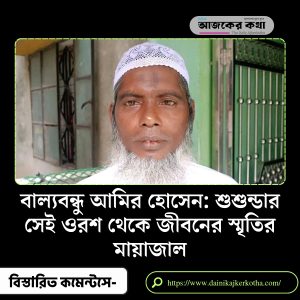
Childhood friend Amir Hossain — that’s how I used to call him. Sometimes, we would jokingly call him “Butuilla,” though I don’t quite remember why. He was my childhood companion. We used to study together at the madrasa’s maktab every morning. I was the mischievous one, but Amir was always innocent and kind-hearted. Despite my pranks, I never caught him doing anything wrong.
Back then, Amir smoked Akij bidi and often invited me saying, “Come on, have an Akij bidi, and then let’s go to some urs celebration at Shushunda or somewhere nearby. There’ll be music, dancing, and we’ll enjoy some khichuri.” Actually, the khichuri at those urs celebrations was something special.
RelatedPost


One time, though, there was no urs anywhere nearby. So at night, around 10 or 11 pm, Amir, Mizan (now a teacher at Dakhil Madrasa), Ibrahim, Harun, my nephew Kasem, and I set out to find an urs. We walked around, ears strained for any sound of music or a microphone. We went as far as Paib, but found no sign of any urs.
In the middle of the night, we asked an elder, “Uncle, do you know if there’s any urs or music happening anywhere around here?” He pointed towards the high bank of the Gomti river near Shushunda, passing through the Borobadh area, and told us, “There’s an urs over there, go check it out.”

We all lit our Akij bidis and walked toward the distant music. When we arrived, it was the era when Ershad Sarkar from Derkipara used to sing. As soon as he saw us, he was overjoyed and instructed the organizers to welcome us warmly. We enjoyed the music and hospitality of that night’s urs.


At dawn, we all walked back home, filled with memories of the night. Those moments still linger vividly in my mind. I wonder where Amir is now. From what I’ve heard, Amir has changed a lot for the better. I hope he is well.

Amir, wherever you are, stay safe and happy. One day, I will write more about you.
It’s worth noting that Amir’s elder sister, Nazma Begum, also known as Nazu, was my classmate — but that was back in school. Amir never went to school; I met him during our madrasa days.