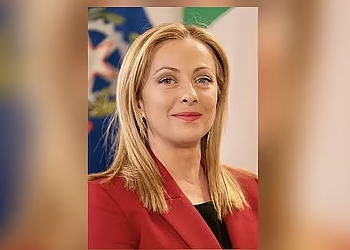



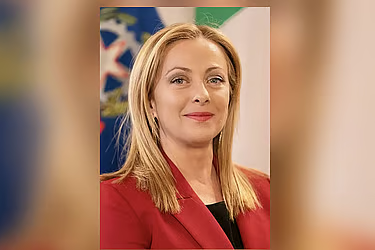
Italy is moving toward banning the wearing of burqas and niqabs in schools, while also planning to set limits on the number of foreign students allowed in each classroom. Prime Minister Giorgia Meloni announced the plans on Sunday.
Speaking at a gathering of the youth wing of her Brothers of Italy (FdI) party, Meloni said the government would soon present a proposal to the cabinet to establish a legal limit on the maximum number of foreign students allowed in each classroom.
RelatedPost

Meloni also said parents of foreign students who face significant difficulties adapting to the Italian education system would be required to learn Italian. The proposal would also include a ban on wearing burqas and niqabs in schools.
Italy is one of the main transit countries for migrants entering Europe. The country is scheduled to hold a general election next year, and the integration of migrants into mainstream Italian society has become an important issue in the political debate ahead of the election.
In July, the National Future (FN) party had called for tighter restrictions on the wearing of burqas in schools. The party is not part of the governing coalition and is generally positioned further to the right than Meloni’s party. Since its launch in February, the party has gained support in opinion polls, according to the report.
Italy currently has no specific law that directly bans burqas in schools or public places. However, a 1975 law prohibits people from covering their face or identity with clothing or helmets without a legitimate reason.
In 2008, Italy’s highest administrative court interpreted the law and ruled that full-face coverings could be worn for religious or cultural reasons. However, people must uncover their faces when identification is required.
Meloni’s coalition partner, the anti-immigration League party, also introduced a bill in the Senate earlier this year. The bill proposed a broader ban on face-covering clothing and helmets, with exceptions for certain settings such as sporting events and places of worship.




Italy already has rules limiting the number of foreign students in classrooms. However, Meloni did not specify exactly how the existing rules would be changed.
According to Italy’s National Institute of Statistics (ISTAT), foreign students account for about 12 percent of all students in Italian schools. Since 2010, rules have generally limited the proportion of foreign students to a maximum of 30 percent in individual classes and schools.
The limit can be increased for foreign students who have sufficient proficiency in Italian. Foreign students born in Italy may also qualify for this flexibility. Conversely, the limit may be reduced when students have insufficient language skills.